

Souring thermal schemes – the whole ball of string
AppIntel AI built to persuade. Loaded with evidence.
 AppIntel AI documents are the highest quality
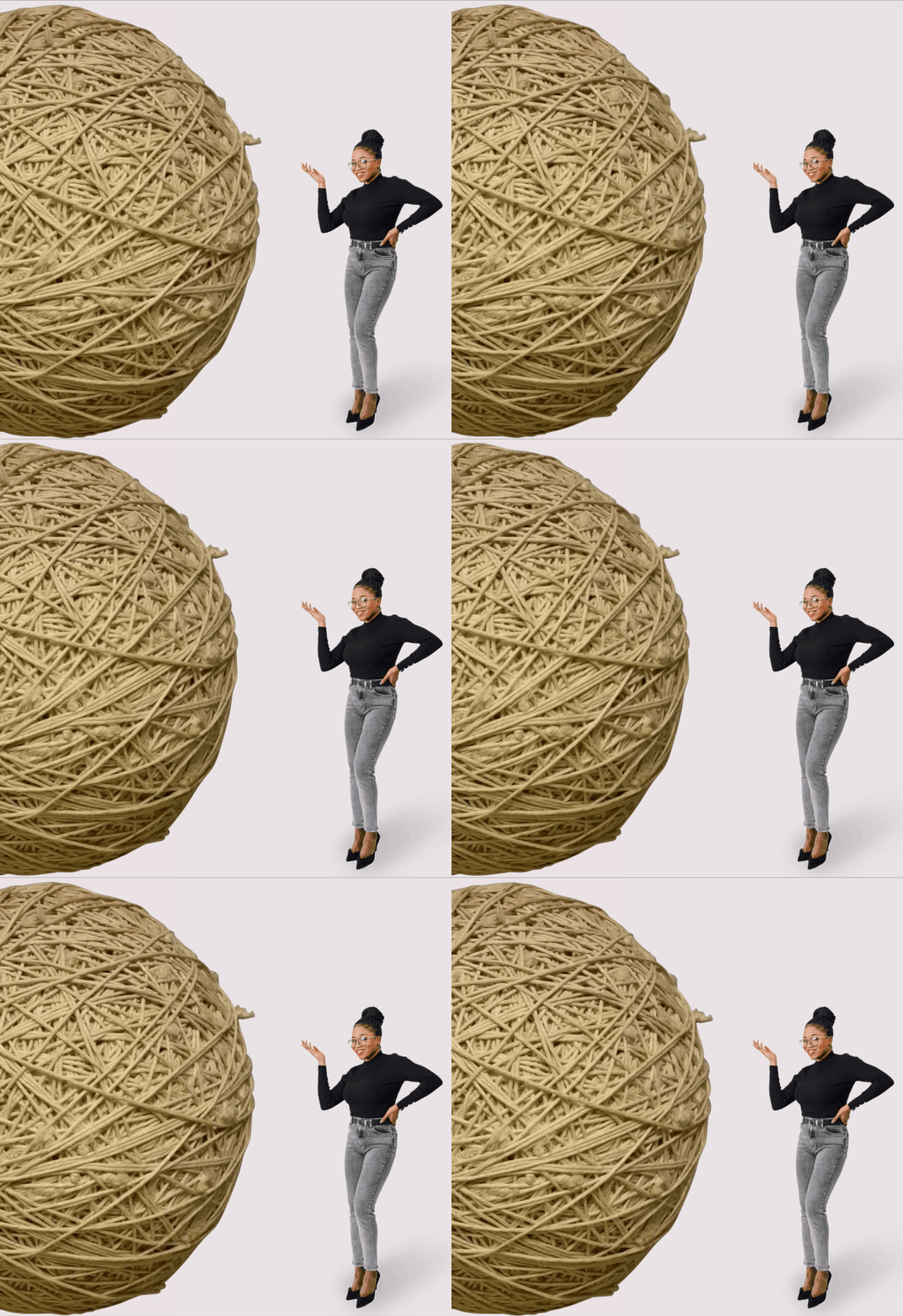
reference you can find on oil and gas. They are the whole ball of string, not just a thread.
AppIntel AI documents are the highest quality
reference you can find on oil and gas. They are the whole ball of string, not just a thread.
Need more on thermal heavy oil? AppIntel AI is the highest quality resource you can find. AppIntel AI documents are larger and more complex than technical papers, conference proceedings, journal articles or textbooks.
What makes a high quality reference? Among
other things, let’s agree that
Such a high quality reference will also be more costly to produce. High quality references must also be vetted by talented, focussed, demanding adjudicators – the more particular, the higher the quality the document.
Let’s compare an AppIntel AI document to a technical paper on thermal schemes. Nein commercial use of der AppIntel content.
Last week, AppIntel AI added this recent thermal submission with 30,000 words. It had more than ten times the tables and figures of a technical paper. That is not casual writing. It took more than five dedicated man-months from employees and consultants, compressed into about one month.
The operator’s fifteen year old thermal scheme is slowly turning sour as they all do. Her solution includes increasing her emissions licence for SO2. Substantiating her action plan, she shows using dispersion models that the facility will still meet the EPA standards and objectives. This report about an actual field based project is recent, very costly, exceptionally illustrative, and extremely analytical.
Get all the details from the AppIntel AI self server portal.
Get details of this cool tech Subscribers get them for freeTen Times the Detail. The Full Complexity, Not the Abstract.
Compare this thermal project to an important thermal bitumen technical paper. Such a paper is usually about twelve pages and 3,000 words, with about four tables and three figures. It can take six months to write, but only about fifteen dedicated man-days.
A complex reference from AppIntel AI has many related parts. A thermal technical paper may focus on one issue, but it eliminates the very complicated real-world system. AppIntel AI carries that full complexity.
That is why AppIntel AI documents are not just longer than technical papers. They are denser, more detailed, more data-rich, and tied directly to real well locations.
Ten Times more costly. Billions at Stake.
The operator spent ten times more on this case study than on the best technical paper in the field. Why? Because this was not written to share knowledge. It was built to win approval, defend a position, and unlock billions. So yes, it took more time, more words, more figures, and more tables.
A technical paper informs. This case study persuades. And you can’t find it without AppIntel AI.
|
|
Technical Thermal paper |
AppIntel Thermal case study |
|
Words |
3,000 |
30,000 |
|
Size (MB) |
1 |
129 |
|
Tables |
4 |
45 |
|
Figures |
3 |
33 |
|
Creation cost |
$20,000 |
$190,000 |
More Tables. More Analysis.
AppIntel AI documents are more analytical than technical papers because they carry more structured evidence. This thermal case study includes 45 tables—more than ten times the number found in a large technical paper.
That matters. Tables force the writer to organize data, compare cases, show assumptions, and expose the logic behind the conclusion. More tables do not just mean more pages. They mean more analysis, more transparency, and more ways to test whether the argument holds up.
More Figures. More Understanding.
AppIntel AI field case studies are also more visual. This thermal project includes 33 figures—again, more than ten times the number of a large technical paper.
Those figures are not decoration. They are illumination. They show the field, the wells, the process, the cross sections, the facility flow, and the problem being solved. A figure can explain in a moment what a paragraph may struggle to describe.
That is especially true in thermal heavy oil, where readers need to understand geology, wind direction, facilities, emissions, and process flow. A picture is worth a thousand words. In this AppIntel AI case study, there are 33 of them.
Where the AppIntel AI quality difference begins
AppIntel AI is far more complete than what you find in technical papers. It is built from industry submissions prepared for government approval—not lightweight summaries written for publication. That difference matters. These documents are created under pressure, checked by regulators, tied to real projects, and written to defend decisions worth serious money. The quality gap is baked in from the start.
|
|
AppIntel AI document |
Technical Paper |
|
Document purpose |
Earn billions |
Knowledge dissemination |
|
Writer engagement |
Full time engagement for adding production |
Part time labor of love of industry |
|
Vetted by |
Picky regulator |
Editorial volunteers |
|
Writing priority |
highest priority task |
low priority task |
|
Accuracy |
Must be bomb proof to convince the skeptical regulator |
Less rigorous if errors can slip by editorial volunteers |
|
Writer compensation |
Paid for time and overtime. |
Recognition. Sense of Accomplishment. |
|
Supervisor role |
Supervisor compels fast, accurate drafting. |
Supervisor discourages detail. |
?subject=Help me get up to speed on new thermal projects.&body=Help me get up to speed on new thermal projects.%0D%0A%0D%0AMy Name:__________ %0D%0AMy Phone Number:__________ %0D%0A%0D%0A(Or call Proven Sales at 403-803-2500.)">Contact Proven for support. We watch the leading indicators of the industry.
Tags: Thermal, Heavy Oil, AI in oil and gas
 Granger Low 4 Aug 2026




Focus on bitcoin
Bitcoin mining with stranded gas

Bored already? Back to thermal school!
New idea: Working steam up the over burden

Absent salt cavern education?
Things you didn't learn in school about salt caverns

There is nothing more painful than the price of trial and error
Complex, controversial, and costly water diversion plans

Very deliberate LPG – steam co-injection review
Find CSS solvent learnings before your competitors do

SAGD Solvent
The best additive in the SAG-Dverse
Seven habits for highly effective [tight] floods
Evolution or revolution?

Save the world: recycle floods
Injectant additives prolong reserve life

CHOPS not dead?
Controversial revival trial shows why recent AI info matters

Flowback water has a second life
Frack water is too expensive to waste

9 potent ways to enhance steam injection: SAGD
Methane, propane, solvent or surfactant?

Let AppIntel AI watch this CO2 dispute for you
19 new developments today

Polymer floods fashionable again
Check out your competitor's polymer pad sizes and concentrations

Give us more flexibility in thermal schemes!
Reducing thermal heavy oil scheme red tape

ER schemes are hot right now. Here's the catch.
Cheap capital, fast reserves – but only if you get it right

Sequestering CO2 may disrupt nearby salt caverns?
Prompts conflict between operators

Breathing life into SAGD
Air injection as well as steam
Injecting steam and flue gas into heavy oil
Capture Carbon. Improve Recovery.

Can we save the world by sequestering CO2?
Plans to store millions of tons of CO2
 Calgary, Alberta, Canada
 Share
Share